
Temp mail without registration is exactly what it sounds like: a disposable email inbox you can use instantly, with no account, no password, and no personal information required.
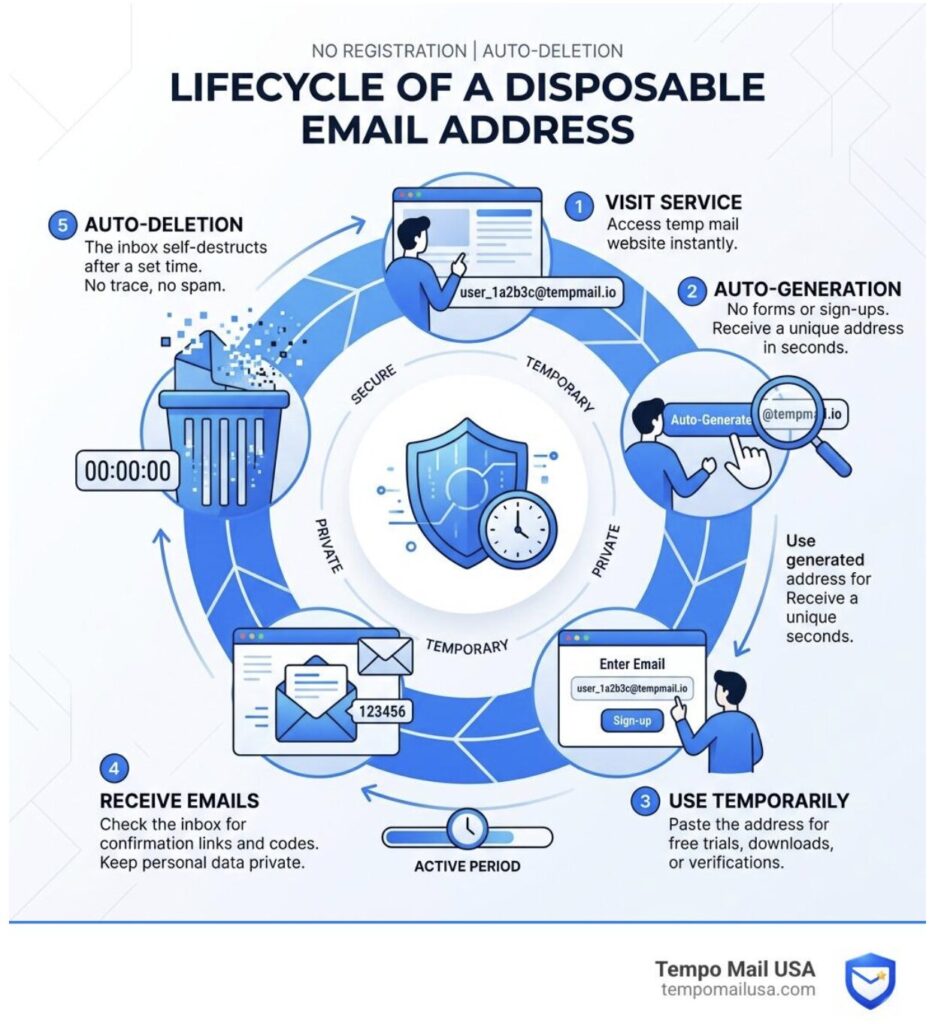
Here’s how to get one in seconds:
- Visit a temp mail service (such as Tempo Mail USA)
- An address is auto-generated for you — no forms to fill out
- Copy the address and paste it wherever a site asks for your email
- Check the inbox on the same page to receive verification codes or confirmation links
- Walk away — the inbox deletes itself automatically after a set time
That’s it. No strings attached.
Most people hand over their real email address dozens of times a year — for free trials, forum sign-ups, newsletters, app downloads. Each time, they’re making a query trade: access in exchange for personal data.
And that trade rarely ends well.
Spam volumes have surged by 73% in recent years. Data brokers operate a market worth an estimated $200 billion, built largely on the email addresses and behavior patterns you leave behind. Every sign-up is a potential entry point for phishing, identity theft, or relentless marketing you never asked for.
A temporary email address breaks that chain entirely. You give out an address that self-destructs. No one can track it back to you. No spam follows you home.
This guide walks you through exactly how masked temp mail services work, which features matter, and when to use them — so you can protect your real inbox without sacrificing convenience.
What is Temp Mail Without Registration?
In the digital landscape of April 2026, your email address is more than just a way to receive messages; it is your digital passport. Temp mail without registration provides you with a “burner” address—a functional mailbox that requires zero setup. Unlike traditional providers which demand your name, phone number, and often a recovery email, these services offer instant anonymity.
Whether you call it disposable email, fake mail, or a transitory address, the core concept remains the same: it is a short-lived tool designed for a single purpose. You arrive at the site, an address is waiting for you, and you use it. There is no password to remember because the inbox is tied to your current browser session.
To understand the full scope of how these tools differ from your standard account, you can explore more about what a Disposable Email Inbox: What It Is & How It Works entails.
How Temp Mail Without Registration Protects Your Identity
Every time you enter your real email into a web form, you are likely being added to a database. These databases are often sold to third parties, contributing to the massive $200 billion data broker market. By using a temporary address, you create a “shield” for your Personally Identifiable Information (PII).
We operate on a zero-knowledge principle. This means the service doesn’t know who you are, and therefore, cannot leak your identity even if a data breach occurs at the site where you signed up. Furthermore, many modern temp mail services strip away marketing trackers that companies embed in emails to see when and where you opened a message. Using these tools is one of the most effective ways to protect yourself from spam and keep your digital footprint small.
The Mechanics of Temp Mail Without Registration
You might wonder how an email address can just “appear” and work instantly. It’s not magic; it’s clever server management.
- MX Records and Catch-all Routing: The service owns several domains and configures their Mail Exchanger (MX) records to point to a central server. This server is set to “catch-all,” meaning it accepts any text string placed before the “@” symbol.
- Redis In-Memory Storage: To keep things fast, many services store incoming emails in Redis, a type of high-speed memory storage. This allows for near-instant message delivery.
- WebSocket and Instant Refresh: Instead of you hitting a “refresh” button repeatedly, modern inboxes use WebSocket technology to “push” new emails to your screen the moment they arrive.
Auto-deletion: Once a timer expires—ranging from 10 minutes to several days—the server wipes the data permanently.
Why You Need a Disposable Shield in 2026
The internet in 2026 is noisier and more dangerous than ever before. With nearly 99% of apps and services requiring an email for sign-up, the opportunities for your data to be harvested are endless.
Phishing prevention is perhaps the most critical reason to use a temporary shield. Phishing attacks often start with a “leak” from a legitimate site you once trusted. If you used a temporary email for that site, the hackers have a dead address. They can’t send a fraudulent “password reset” link to your real inbox because they don’t have your real address.
Additionally, bot harvesting is a constant threat. Bots crawl forums and public comments looking for the “@” symbol to add to spam lists. If you must post an email address publicly, using a disposable one ensures that when the bots inevitably find it, they find a mailbox that no longer exists. Understanding why temporary email is essential is the first step toward reclaiming your online peace.
Step-by-Step: Creating Your First Anonymous Inbox
Getting started with temp mail without registration is designed to be the path of least resistance. We have refined the process so that it takes fewer clicks than checking your actual mail.
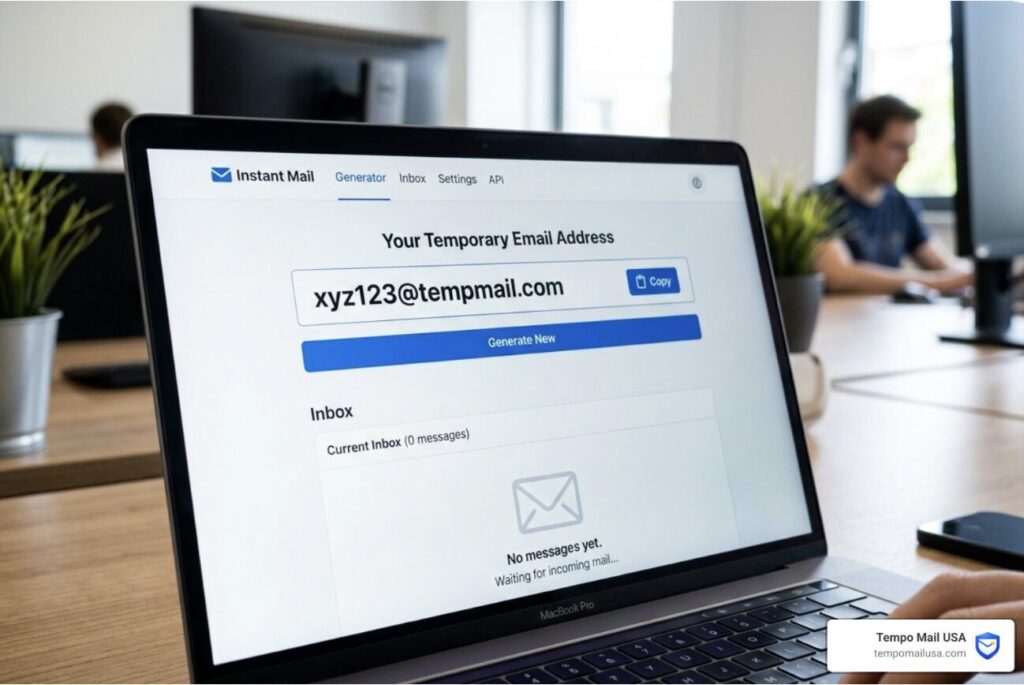
- Generate: Simply open the service page. A unique address like user_7492@domain.com will be waiting for you.
- Copy: Use the one-click copy button or scan a QR code if you are using your mobile device.
- Paste and Register: Use this address on the site requesting your info.
- Wait for the OTP: Stay on the temp mail page. Within seconds, the verification code or HTML email will appear in the “Inbox” section of the page.
- Verify: Click the link or copy the code to finish your sign-up.
This process is perfect for safe online sign-ups, especially when you’re dealing with a service you only plan to use once.

Comparing Temporary Addresses vs. Permanent Aliases
Not all “fake” emails are created equal. Depending on your needs, you might want something that lasts ten minutes or something that lasts months.
FeatureTemporary Email (No Reg)Permanent Email AliasLifespan10 mins to 7 daysPermanent until deletedRegistrationNone requiredRequires account setupSendingReceive only (usually)Can send and replyStorageRedis (In-memory)Standard server storageBest ForOne-time verificationsLong-term newsletters
While temp mail without registration is the king of speed and anonymity, permanent aliases (like those offered by Tempo Mail USA) act as a middleman for your real inbox. They forward mail to you, allowing you to keep the address for months while still shielding your PII. For a deeper dive into which is right for you, check out the top temporary email services.
Best Practices for Social Media and App Testing
Temporary mail isn’t just for avoiding newsletters; it’s a powerful tool for power users and developers.
- QA Testing: Developers use disposable addresses to test registration flows. Instead of creating 50 real permanent accounts, they generate 50 temp addresses in seconds to ensure their app’s email triggers are working correctly.
- Trial Extensions: Many services offer a 7-day free trial. While we always encourage supporting creators, temp mail allows users to explore a service’s features thoroughly before committing.
- Social Media Anonymity: Whether it’s Discord, Reddit, or even dating apps, using a temporary email ensures that your “burner” social profile isn’t linked to your professional identity.
Mastering these temporary email tools can significantly streamline your digital workflow.
Frequently Asked Questions about Anonymous Email
Can I receive attachments and HTML emails?
Yes, most modern services, including those we recommend, support full HTML rendering. This means the emails look exactly like they would in a standard email client, with buttons and images intact. Many services allow attachments up to 5MB. These files are typically stored in Redis in-memory storage, meaning they are fast to download but will disappear forever once the mailbox expires. For security, many providers use sandboxed rendering to prevent malicious scripts in the email from attacking your computer. You can read more about this on Tempma.
How long do temporary emails typically last?
Lifespans vary by provider. The most common “burner” addresses last for 10 minutes (the classic “10-minute mail”). However, some services offer a 1-hour window or even a 7-day persistence if you keep the browser tab open. At Tempo Mail USA, we focus on flexibility—some addresses are ephemeral, while others can be kept longer for medium-term needs. Generally, if there is no activity for a set period, the system triggers an inactivity expiration to purge the data.
Is it safe to use temp mail for banking or sensitive accounts?
No. We strongly advise against using a temporary email for banking, government services, or any account containing sensitive health or financial data. Because these inboxes do not require a password, they are not intended for long-term security. If you lose access to the browser session, there is no recovery—your account could be locked forever. Use temp mail for the “noise” of the internet, and save your real, secured inbox for the “signal.”
Conclusion
In an era where your data is the most hunted commodity on earth, temp mail without registration is your most effective defense. By acting as a privacy firewall, services like Tempo Mail USA ensure that you can explore the web, test new apps, and sign up for services without leaving a trail of personal breadcrumbs for hackers and advertisers to follow.
Don’t let your primary inbox become a graveyard for spam and a target for data breaches. Use a proxy for your identity, shield your PII, and take back control of your digital life. Visit https://tempomailusa.com today to generate your first secure alias and start browsing with peace of mind.