Introduction
Engineers and procurement managers face a dual mandate: achieving extreme precision under relentless cost pressure. Choosing a supplier on price alone risks budget overruns and delays, as the true expense is the Total Cost of Ownership—driven by scrap, rework, and inefficiency. This framework helps identify partners who use engineering and process excellence to reduce real costs, not just initial quotes.
Why Does the “5 axis CNC machine price” Quoted Not Equal Your Total Cost of Ownership?
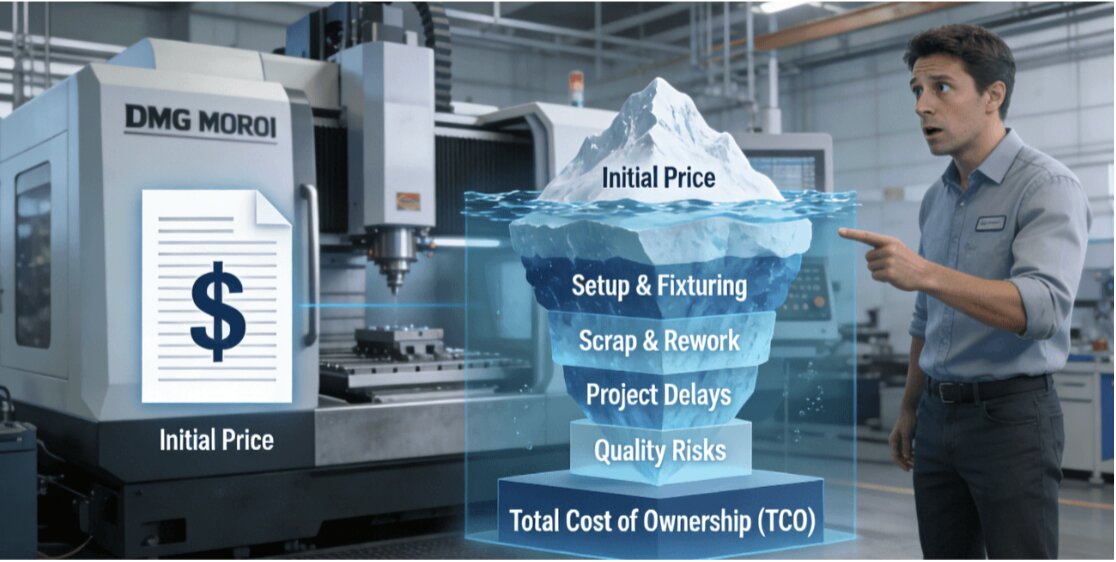
The quoted “5 axis CNC machining price” reflects only direct costs like materials and machine time. The true Total Cost of Ownership (TCO) includes significant hidden costs that erode profits. Beyond explicit expenses, inefficiencies like multiple setups increase time and error. Poor planning leads to material scrap and costly rework.
Furthermore, a lack of engineering support can result in late-stage design changes, causing project delays and substantial opportunity costs. As noted in manufacturing cost analysis, ignoring these hidden process inefficiencies is a primary profit killer. Therefore, choosing a partner who optimizes the entire workflow to minimize TCO is far more critical than comparing initial rates. This decision determines if your CNC Machined Components become valuable assets or costly liabilities.
What Technical Capabilities Beyond “5 axis CNC machine” Count Should You Evaluate in a Supplier?
Owning advanced 5 axis CNC machine units is merely the entry ticket. The true transformation of equipment potential into client value lies in the “soft power” of deep technical engineering prowess. Evaluation should focus on three key dimensions:
Engineering Support Capability: The Value of DFM Analysis
A supplier’s engineering support, particularly through DFM analysis, is invaluable. It optimizes part designs for manufacturability upfront, suggesting modifications that reduce machining difficulty and cost. More critically, it identifies potential fabrication issues early, preventing costly errors, rework, and delays during production.
- The Starting Point for Cost Optimization
A proficient supplier conducts an in-depth DFM analysis of your 3D model before quoting. This goes beyond checking if a part is “makable”; it involves proposing optimizations from a manufacturing lens. Suggestions might include adjusting internal corner radii to avoid expensive micro-tools or re-designing an overly complex monolithic part into an easier-to-machine assembly, significantly reducing difficulty and cost.
- Front-Loading Risk Mitigation
DFM analysis identifies design features prone to vibration, distortion, or difficult inspection early, proposing modifications. This preemptively avoids quality risks and scrap during production, ensuring smoother project execution.
Integrated Service and Digital Competence
In today’s manufacturing ecosystem, the ability to provide a seamless online 5-axis CNC machining services experience is crucial. This includes a clear online quoting and ordering platform, real-time project tracking, and streamlined digital communication and file management. Such integrated services significantly reduce procurement overhead and enhance collaboration efficiency. To access this level of deep analysis, one can engage a specialized 5 axis CNC service.
For Complex Parts, How to Choose Between 3+2 Positioning and 5-Axis Simultaneous Machining to Balance Cost and Precision?
In custom 5-axis CNC machining manufacturing, understanding the distinction between 3+2 positional and 5-axis simultaneous machining and making the correct choice is key to controlling costs and ensuring precision.
3+2 Positional Machining (or 3+2 indexing) essentially locks the two rotary axes of a 5-axis machine at specific angles, fixing the tool orientation relative to the workpiece, then performs milling similar to 3-axis work. It is ideal for prismatic parts like valve blocks, brackets, or housings with multiple angled holes/faces. Its advantages are relatively simpler programming, the ability to use shorter, more rigid tools for efficient cutting (yielding better surface finish), and typically lower cost.
5-Axis Simultaneous Machining involves the continuous, coordinated movement of all five axes (X, Y, Z, and two rotary) during the cut, allowing the tool to maintain the optimal orientation relative to complex contoured surfaces. This is the only method for machining continuous, complex geometries like impellers, propellers, aerospace blisks, or precision mold cores. It delivers unmatched surface quality and profile accuracy, avoiding the “stair-stepping” effects possible with 3-axis machining on complex curves.
How Do International Quality Certifications (e.g., ISO 9001, AS9100D) Tangibly Impact Part Quality and Project Risk?
International quality certifications like ISO 9001 represent a rigorous process system that reduces risk, not just wall decorations. They enforce controlled, repeatable procedures from order to delivery. Industry-specific standards go further: IATF 16949 adds stringent requirements for automotive reliability and defect prevention, while AS9100D is the aerospace benchmark for safety, traceability, and risk management.
Through documented procedures, audits, and training, these systems ensure every batch of parts—from structural components to delicate Custom Film Parts—conforms to specification. This minimizes variation in sourcing and production, guaranteeing batch-to-batch consistency and significantly lowering the risk of failures, recalls, and associated financial loss.
Case Study: How Professional “5 axis CNC machining services” Achieve a Win-Win in Cost and Performance
Project Background and Initial Challenge
A medical device company needed to develop a critical stainless steel structural component for a new surgical robot. The part featured thin walls, deep cavities, and multi-angle inclined holes, with precision requirements of ±0.01mm. Supplier A (a conventional machine shop) quoted a very attractive initial price based on a process split across multiple 3-axis operations.
Expert Intervention and Engineering Optimization
The expert supplier initiated a deep DFM analysis, suggesting subtle design modifications to enhance machinability without compromising function. They then engineered a custom, single-setup fixturing solution and employed a hybrid 3+2 and 5-axis simultaneous machining strategy. This comprehensive optimization of both design and process delivered substantial gains in efficiency and first-pass yield.
- DFM Analysis for Cost and Efficiency
Supplier B, possessing top-tier 5 axis CNC machining services capabilities, first conducted an in-depth DFM analysis. Engineers suggested slight reinforcement of several ultra-high aspect ratio ribs and standardized tolerance bands for non-critical areas. These changes minimally impacted function but significantly improved machinability and rigidity.
- Process and Fixturing Innovation
Supplier B employed a 5-axis machine, designing a custom flexible fixture for single-setup machining of all five sides, and utilized a hybrid strategy of 3+2 positional and 5-axis simultaneous programming. Optimized tool paths and cutting parameters reduced single-part cycle time by 40% while maintaining precision.
Outcome Comparison and Value Demonstration
Supplier A’s production was fraught with issues: thin-wall deformation and tool breakage led to a scrap rate exceeding 30%, culminating in a 6-week delivery delay and costs far exceeding budget. While Supplier B’s unit price was approximately 15% higher, their mature and stable process achieved a first-pass yield of 98.5% with on-time delivery. Factoring in material, scrap, time, and management costs, Supplier B’s solution saved the medical company over 25% in Total Cost of Ownership while securing the project timeline. This clearly demonstrates that professional engineering value far outweighs superficial low price.
Conclusion
Selecting a 5-axis CNC machining partner is fundamentally a decision about value, not just price. By focusing on Total Cost of Ownership over the initial quote, deeply evaluating a supplier’s technical engineering and process planning capabilities, understanding the application of 3+2 positional versus 5-axis simultaneous machining to balance economy and precision, and trusting in processes backed by internationally recognized quality systems, manufacturers can achieve cutting-edge part performance (such as ±0.005mm tolerances) while effectively controlling overall costs.
Your next complex component project deserves the optimal balance of cost and performance. Get an instant quote today to receive a transparent quotation including professional DFM analysis and experience the real value of engineering optimization firsthand.
About the Author
The author is an engineer with over 15 years of experience in precision manufacturing, specializing in advanced machining technologies and supply chain optimization. He has deep expertise in 5-axis CNC machining processes and manufacturing cost models.
FAQs
Q: What is the smallest feature size and highest accuracy 5-axis CNC machining can handle?
A: This depends on the specific equipment and material. Top-tier service providers can handle feature details smaller than 0.4mm and maintain tolerances of ±0.005mm or tighter. A specific assessment based on the part design is required.
Q: Besides metals, what engineering plastics can 5-axis CNC machine to control costs?
A: Absolutely. High-performance engineering plastics like PEEK, ULTEM (PEI), and POM (Acetal) are common choices. For certain prototypes or light-load applications, using engineering plastics instead of metals can significantly reduce both material and machining costs.
Q: How can I quickly get a reliable “5-axis CNC machining price” estimate?
A: Provide a clear 3D model (STEP/IGES format), 2D drawings with critical tolerances noted, along with material, surface finish, and quantity requirements. Professional service providers’ online quoting systems can quickly generate a transparent quote based on this information.
Q: Is 5-axis CNC economically viable for small-batch R&D projects?
A: It is feasible. Professional online manufacturing services have lowered the barrier for small-batch 5-axis machining. By consolidating orders and optimizing fixturing and programming, cost-competitive solutions can be obtained even for batches of 1-50 parts.
Q: How is my part design’s intellectual property secured during the machining process?
A: Always sign a Non-Disclosure Agreement (NDA) with the supplier. Reputable service providers have strict data security protocols, ensuring client files are processed on encrypted servers with access limited to relevant project personnel.